
The One-Sentence Rule
If the door doesn't stay put when you lift it halfway and let go, something in the system is already working harder than it should. That's the fastest gut-check for spring balance, and it catches more hidden problems than almost anything else in a standard walkthrough. The exceptions: a door that's brand new may balance fine and still have the wrong wind-load rating for this area, and a door that fails the lift test might just need a spring adjustment rather than a full system replacement. Balance alone doesn't tell you everything — which is why a general home inspector, who's checking dozens of systems in one visit, often treats the garage door as a single pass/fail item instead of walking through what's underneath.
Walk the Garage: A Buyer's Checklist
1. Manual Balance Test
Disconnect the opener (pull the red emergency release cord) and lift the door by hand to waist height. Let go. It should hold. If it drops, the springs are worn or mismatched for the door's weight — a repair most buyers never think to budget for, and one that can run from a straightforward spring swap to a full torsion system replacement depending on age and door size.
2. Track Condition at the Base
Look at the bottom two feet of each vertical track, where splash-back from afternoon downpours collects. Surface rust here is common; flaking, pitted metal or a track that's visibly bowed outward means moisture has been sitting against it for a while. A bent or swollen track at the bottom is one of the most common causes of a door that looks fine standing still but binds or jumps when it runs.
3. Cable Fraying at the Bottom Bracket
Crouch down and look at the lifting cables where they wrap around the bottom corner brackets. Any broken strands, kinks, or rust bloom on the cable itself is a sign it's near the end of its life. A cable that lets go mid-cycle can drop a door unevenly, and it's one of the few garage door failures that's a genuine safety issue, not just an inconvenience.
4. Weatherstripping and Bottom Seal
Check the rubber seal along the bottom of the door and the vinyl strips along the sides. In this climate, cracked or flattened seals let humid air and wind-driven rain in, which speeds up rust on the inside of steel panels and can warp wood-composite doors. If the seal looks dried out or there's visible water staining on the slab just above it, water has been getting in during storms.
5. Panel Rust and Delamination, Especially at the Bottom
Run a hand along the inside and outside of the bottom panel. Bubbling paint, soft spots, or rust working its way up from the bottom edge usually means moisture has been wicking into the panel for months, sometimes longer than a current owner has noticed. This is a slow failure — the panel still functions, right up until it doesn't, and panel replacement is a far easier repair when caught early than when the whole section needs to come out.
6. Opener Age and Safety Reversal
Ask how old the opener is, then test it: set a 2x4 flat on the ground where the door closes. A working safety reversal system will stop and reverse the instant the door touches it. If it doesn't reverse, or the photo-eye sensors near the floor are missing, misaligned, or taped over, that's a safety gap that needs fixing before the opener is trusted with regular use — not an upgrade to put off.
7. Wind-Load Bracing
Open the door and look at the back of the panels for horizontal struts — metal reinforcement bars running across the width of the door. Homes in this part of Florida need doors built to handle storm-season wind loads, and older doors, especially ones installed before current bracing became standard, sometimes have none. A door without adequate bracing is a real vulnerability once hurricane season winds pick up, and it's one of the easiest things for a buyer to miss because it's not visible unless you're actually looking at the back of the panel.
8. Hardware Corrosion
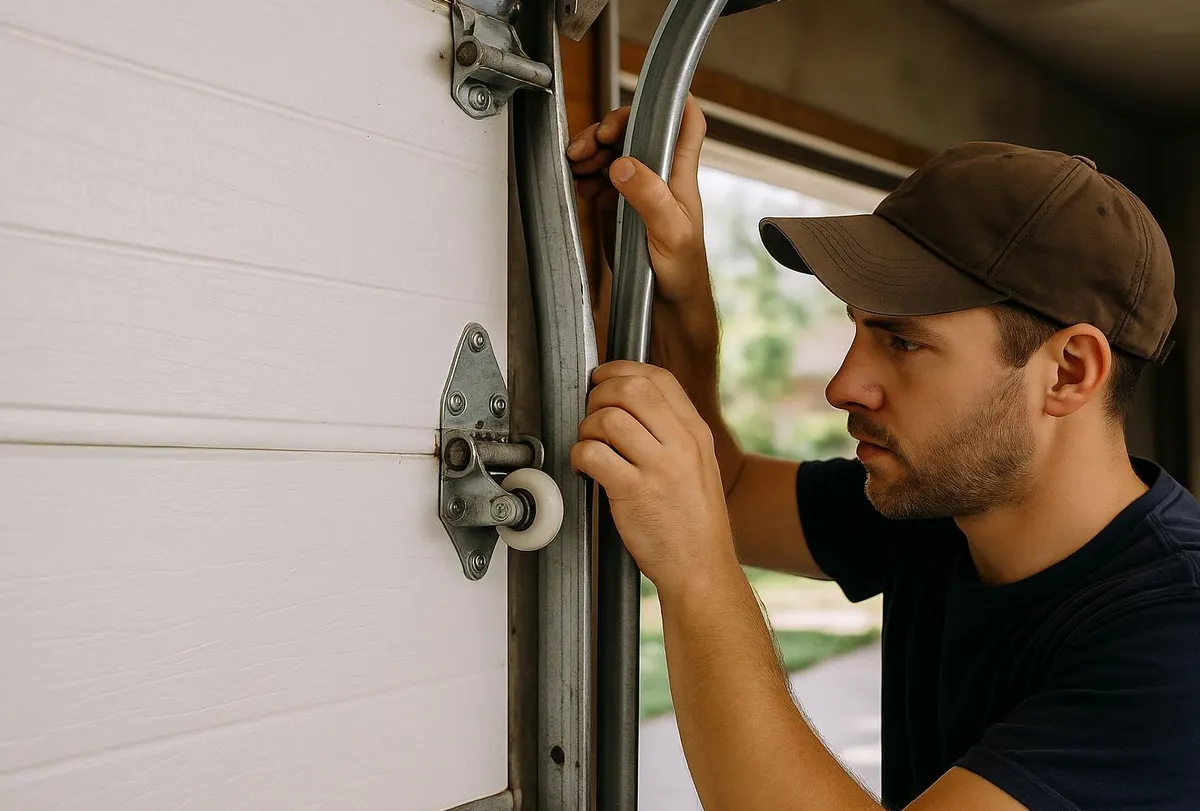
Check hinges, roller stems, and fasteners for rust or seizing. Humidity and, in areas closer to the coast, salt air both accelerate corrosion on exposed metal hardware. Hinges that are rusted stiff put extra strain on the opener and can crack a panel over time if they're not moving freely.
9. Noise and Vibration During a Full Cycle
Run the door up and down once with the garage otherwise quiet. Grinding, popping, or a visible wobble partway through the cycle usually points to worn rollers or a track that's slightly out of alignment — neither is an emergency on its own, but both get worse under daily use.
10. Emergency Release Function
Pull the red release cord and make sure the door separates from the opener carriage smoothly, then reconnect it. A release that's stuck or won't re-engage properly is a safety issue if the power ever goes out during a storm and the door needs to be operated by hand.
When to Call Cottondale Garage Door Repair
If the balance test fails, the cables look worn, or you can't tell whether the door has proper wind-load bracing, that's a job for a technician rather than a guess before closing. Cottondale Garage Door Repair can run a full tune-up and maintenance check to catch rust, alignment, and hardware wear before move-in, and handle spring repair or panel replacement on the spot if the inspection turns up something more serious. We serve homeowners and buyers throughout Cottondale, Marianna, Chipley, Graceville, Campbellton, Grand Ridge, Sneads, and Greenwood.
If you're closing on a home in Cottondale, FL and want the garage door checked properly before it's officially your problem, call Cottondale Garage Door Repair and we'll walk through it with you.